Two Grants, and What They Buy
Cost-share through NRCS EQIP, and a Texas Parks & Wildlife Pastures for Upland Birds (PUB) grant.
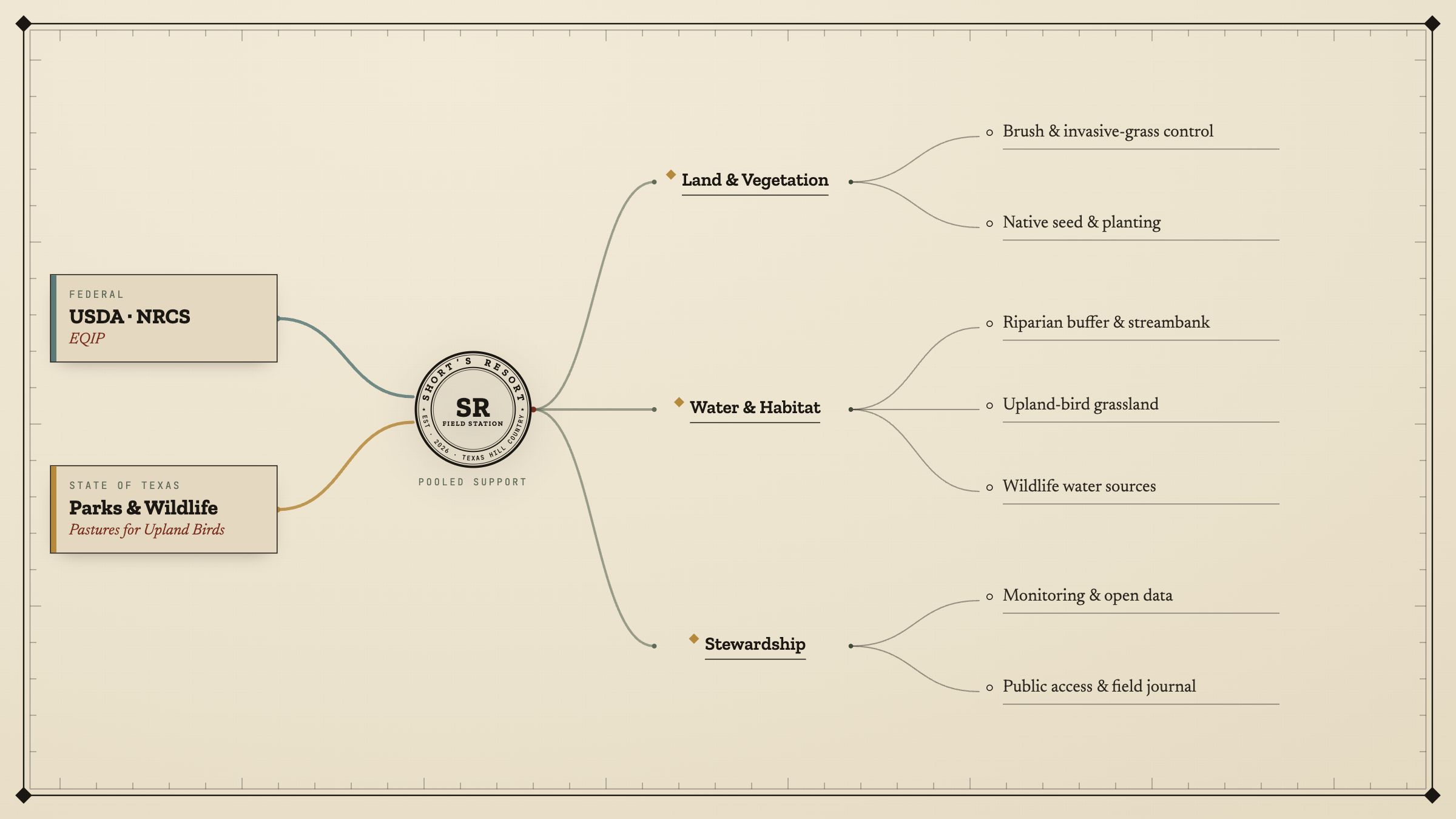 Fig · What the two agreements underwrite, by category of work
Converting an income-producing hay field to a native prairie is both labor- and cost-intensive, and it was a big decision for our family to make. How do you forgo the income while also paying for the restoration? How is the property sustained once all the hay is replaced by native species? Some of these answers we have figured out, and some are still questions, but we want to be straight with you on how we got started, what our plan is to see this project through, and what we're thinking about to sustain management of the land in the longer term.
When we first started researching how to take this on, we fairly quickly stumbled across two grant programs that provided a lot of answers. We applied and now have two agreements that cover a good chunk of our initial restoration phases. The first is cost-share through the USDA Natural Resources Conservation Service under the Environmental Quality Incentives Program — NRCS EQIP — run through the Lampasas County field office. The second is a Texas Parks & Wildlife grant under Pastures for Upland Birds (PUB), which helps landowners turn exotic-grass pasture back into native prairie for grassland birds.
What the support covers
The NRCS EQIP cost-share is tied to specific, named conservation practices — riparian buffer establishment, brush management, native seeding, and a windbreak along the eastern boundary. Under PUB, Texas Parks & Wildlife supplies the herbicide for the knockdown, the native grass-and-forb seed mix, and technical guidance for converting our Tifton 85 hayfield to native prairie. Neither one covers the work on the cabin, and neither goes to anyone as a salary.
After site visits and consultations with biologists and grants administrators from Texas Parks & Wildlife and the NRCS, we developed a phased restoration plan for the property. We would start with 35 of the 90 acres that are currently planted in Tifton 85 bermudagrass (hay), kill it off with two timed glyphosate treatments, reduce thatch through prescribed burns and mulching, and plant the seed mix designed by Texas Parks & Wildlife that is tailored to our location and soil types.
This plan gave us two big wins. We get to see how well the glyphosate kill treatment, as designed, takes on the existing Tifton, then how well the native seeds take to our soils and topography, and how effective they are at crowding out any Tifton that re-emerges in these zones. This functions as a small test run on the property, rather than trying to take on the full 90 acres in one go. We get to see what works, what doesn't, and recalibrate if need be before we take on the rest of the field. We chose to plant on the high ground of the property and cut breaks in between the Tifton and the native planting to keep separation between the two. The second win is that it gives us one or two more hay harvests to help refill the coffers. They will be smaller harvests than in the past, but large enough to provide meaningful reinvestment in the land. We will keep tabs on how all this goes and report here as each part of phase 1 is complete.
Why say so
If you're thinking about similar work on your own ground, both programs are worth a conversation with your local NRCS office and your TPWD biologist. The paperwork is real, but the cost-share is what makes a project this size possible for a small family holding.