Propagation Unit No. 01
The goals, and the full build list, for the first semi-automated propagation bench.
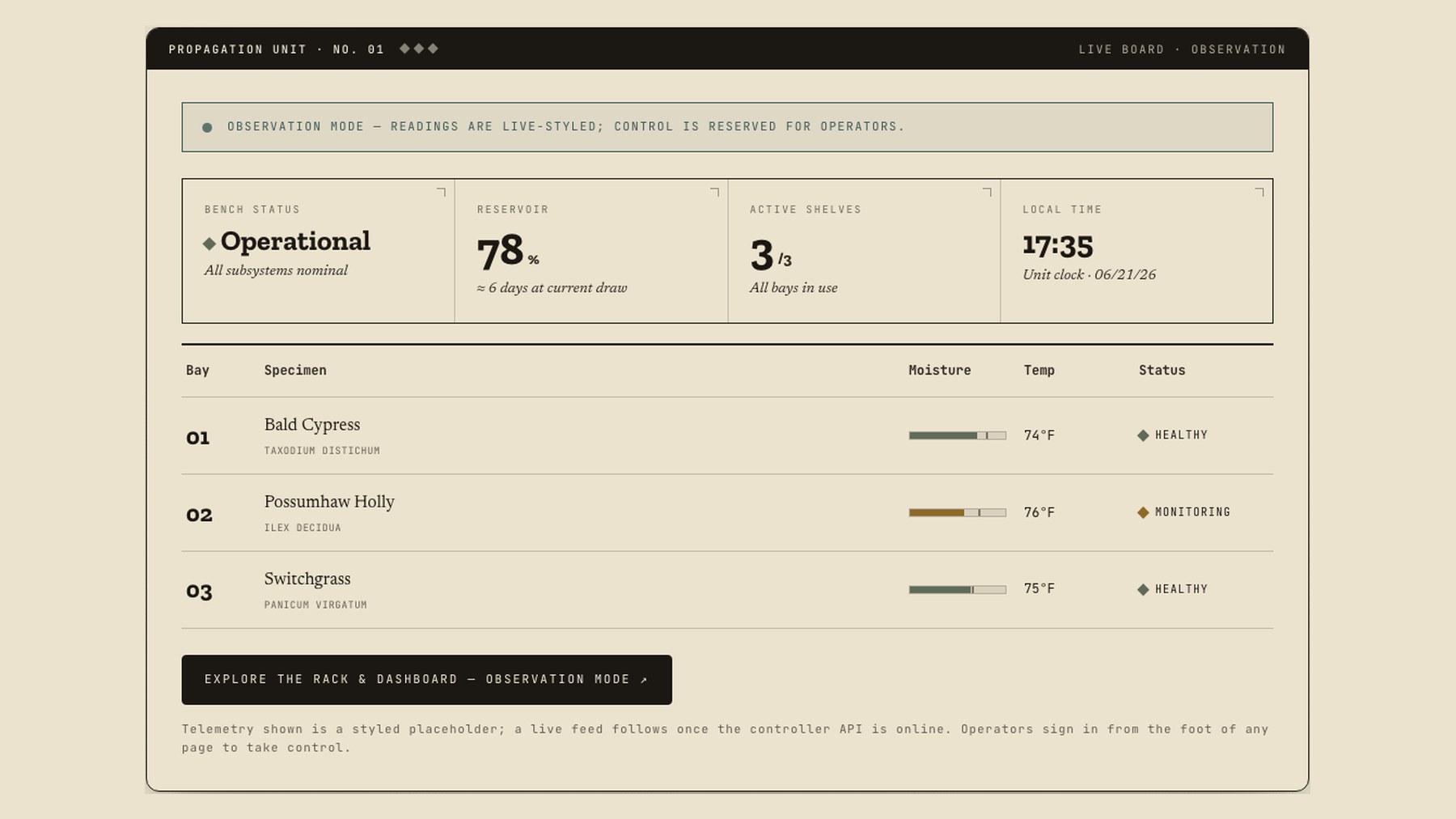 Fig · The unit’s live board, observation mode · telemetry is a styled placeholder until the controller API is online
We had a lot of help from Texas Parks & Wildlife in determining our prairie and grassland mix for the property, but along the way we had conversations about trees, shrubs and forbs as well. While the Tifton field is our biggest pain point, we also have a good stretch of the property along the Lampasas River, which we refer to as the River Conservation Strip. This area has historically been trampled by cattle, overgrazed, eroded by the river and field runoff, and has suffered serious damage from oak wilt, which took out about six of our large red oaks. A small tornado also ripped through the strip about fifteen years ago, toppling some large cottonwoods and a bur oak that still thrives despite now growing horizontally. Rehabilitating the river conservation strip entails planting new oak-wilt-resistant tree species, an understory, and an array of native woody shrubs for wildlife forage and refuge. These plantings will thin and differ in species as they spread into the restored fields, shifting from riparian species to oak savannah and prairie.
But where are all of these species going to come from? We have plans to order saplings from Texas A&M's West Texas Nursery, and we have a handful of native nurseries in Austin that are fantastic resources, but as I continued to search, I had trouble finding reliable and cost-effective sources for some of these species, particularly the shrubs and small trees, that I would need to eventually fill out 100 acres, even over a long period of time. After several walks and surveys on the property, I came to realize the borders of the property were more diverse and populated than I had originally thought. We had a ton of existing native species offering up clippings, root suckers, transplant seedlings, and seeds that were ripe for the taking, and propagating those plants would help preserve our local ecotypes. Thus, the first off-site project for the property was born: Propagation Unit 1.
The first Propagation Unit is a three-shelf bench that raises native restoration stock from seed and cutting with as little daily babysitting as the work allows. We built it deliberately small. One shelf rack, off-the-shelf parts, and a controller with custom software to manage the rack. We built it to propagate seedlings and nurse root cuttings and suckers back to health through the hellish Texas summers. We wanted to focus on the plants that are uncommon in nurseries or cost-prohibitive, things like agarita, buttonbush, black willow, Chickasaw plum, and elbow bush. Things that exist on the property in very small quantities, that we can help establish and repopulate as the restoration progresses.
How it works
We basically built a tiny indoor native nursery. The unit holds each shelf inside a target moisture band, and runs grow lights on a season-specific photoperiod. We automated air movement with small controlled fans, and everything is bottom-watered via flood trays, and only when that shelf's moisture drops below what the species requires. Our software saves the species by shelf, logs every reading and cycle, and gives us useful data for each species we propagate. This makes it easier to pin down issues with some of the more difficult species (I'm looking at you, agarita).
- Rack — three growing shelves, 01 through 03, on a steel wire frame
- Controller — a single-board Piconium reading moisture, temperature and reservoir level
- Water — 120 L reservoir, diaphragm pump, one solenoid valve per shelf
- Light — full-spectrum bars on a per-shelf schedule
- Air — USB circulation fans on the rack
- Interface — a 5″ Waveshare touchscreen at the rack and a web dashboard
Bill of materials
The full parts list, with the engineering notes, lives in the repo at docs/HARDWARE.md. The short version:
- Compute — a Piconium single-board computer (x86, 4 GB RAM) running Debian
- Display — Waveshare 5″ 800×480 touchscreen (HDMI + USB touch)
- Relays — Numato 8-channel USB relay module
- Serial — an FTDI RS485 adapter (FT232RQ + SP485EN)
- Grow lights — Barina full-spectrum bars, 120 VAC
- Fans — 12 V USB circulation fans
- Pump — a SEAFLO 12 VDC diaphragm pump
- Valves — three U.S. Solid 12 VDC solenoid valves, one per shelf, normally closed (they fail shut on power loss)
- Soil probes — RS485 multi-parameter soil probes (moisture, temperature)
- Reservoir sensor — a submersible hydrostatic level transmitter (RS485)
- Reservoir — a 120 L tank
- Rack — a three-shelf steel wire frame
The project is still under construction, but once complete the interface will be public and we will publish more about what we are growing and how it's going. Once the controller is running on the bench's own single-board computer, the same rack screen and dashboard we use will publish over on Instruments & Infrastructure on this site, read-only, so you can see what's actively happening on the bench. Until then the screens live in the repo.
The code is open source too — the full build, controller and dashboard live at github.com/Short-s-Resort-Field-Station/propagation-controller.