The Second Burndown, and Getting Ready to Plant
Agrotech came back in September to fly the cleanup pass, catching what the first burndown missed, and any bermuda that managed to come back. Then the rest of the work that has to happen before seed goes in this winter.
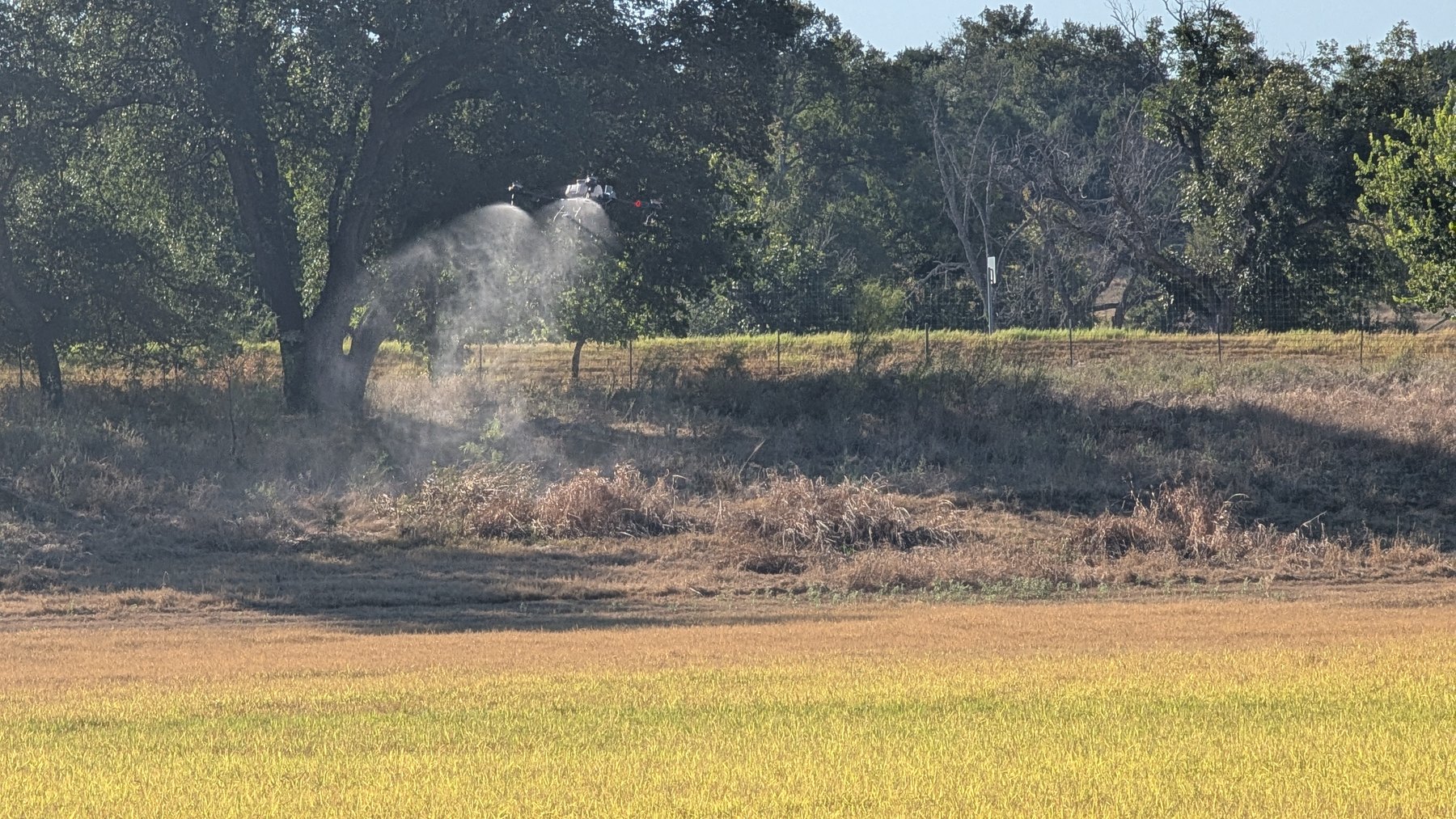 Fig · The drone working the woody edge, where a tractor and boom can't go · 22 September 2026
The trailer was parked on the field edge with the tanks full a little after nine, and the drone was back on the flatbed by a quarter to twelve. Two and a half hours, and that was the whole of it. The second glyphosate pass we discussed in June flew in September. There wasn't a whole lot of green Tifton that popped back up, but what did, we doubled down on this round.
The first burndown did the heavy work of the kill, and it did quite a job. This one was cleanup over the 35 acres. We had occasional strips the first application didn't quite reach, and the bermudagrass and Johnsongrass that came back from rhizomes, as we had expected.
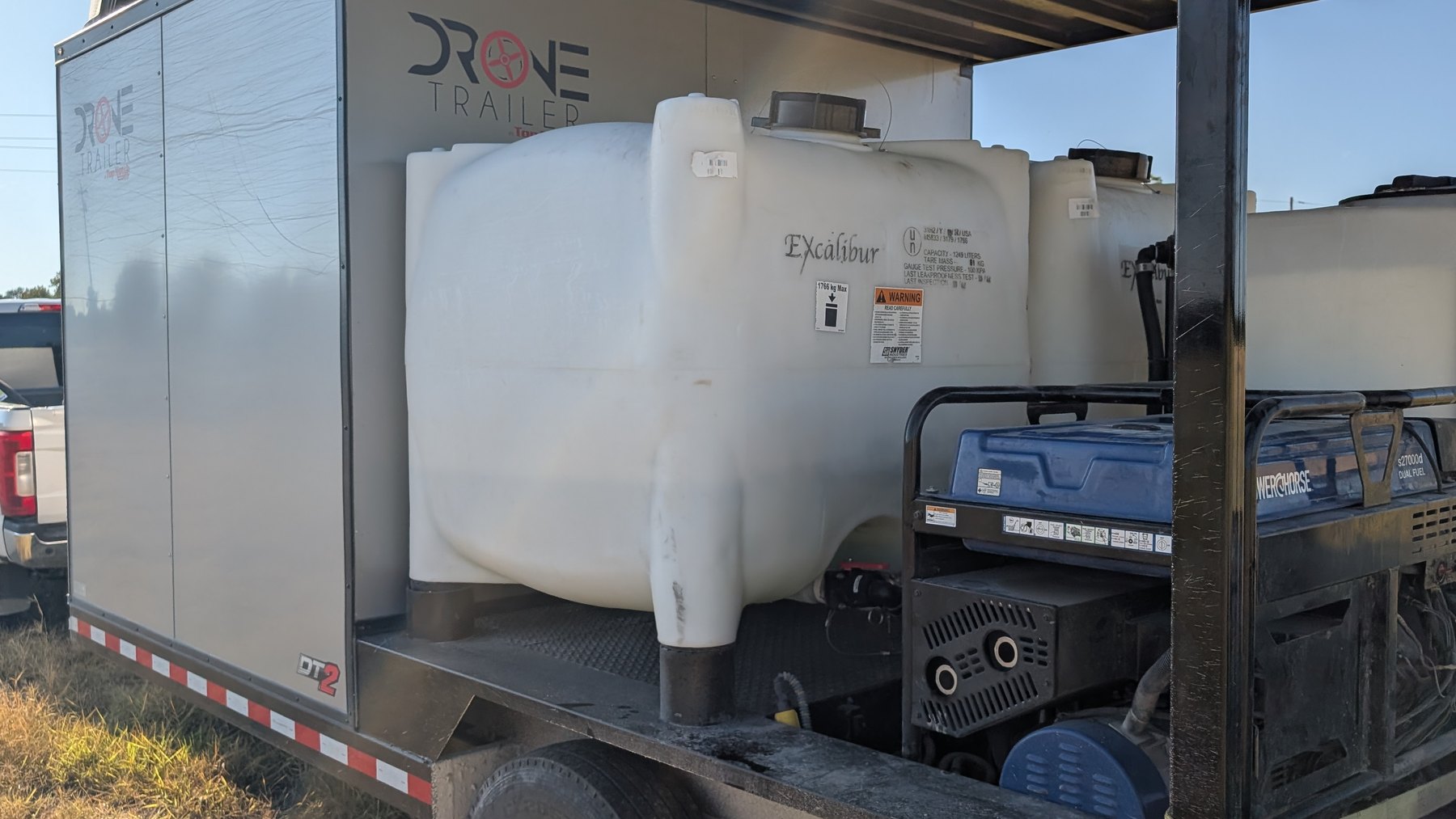
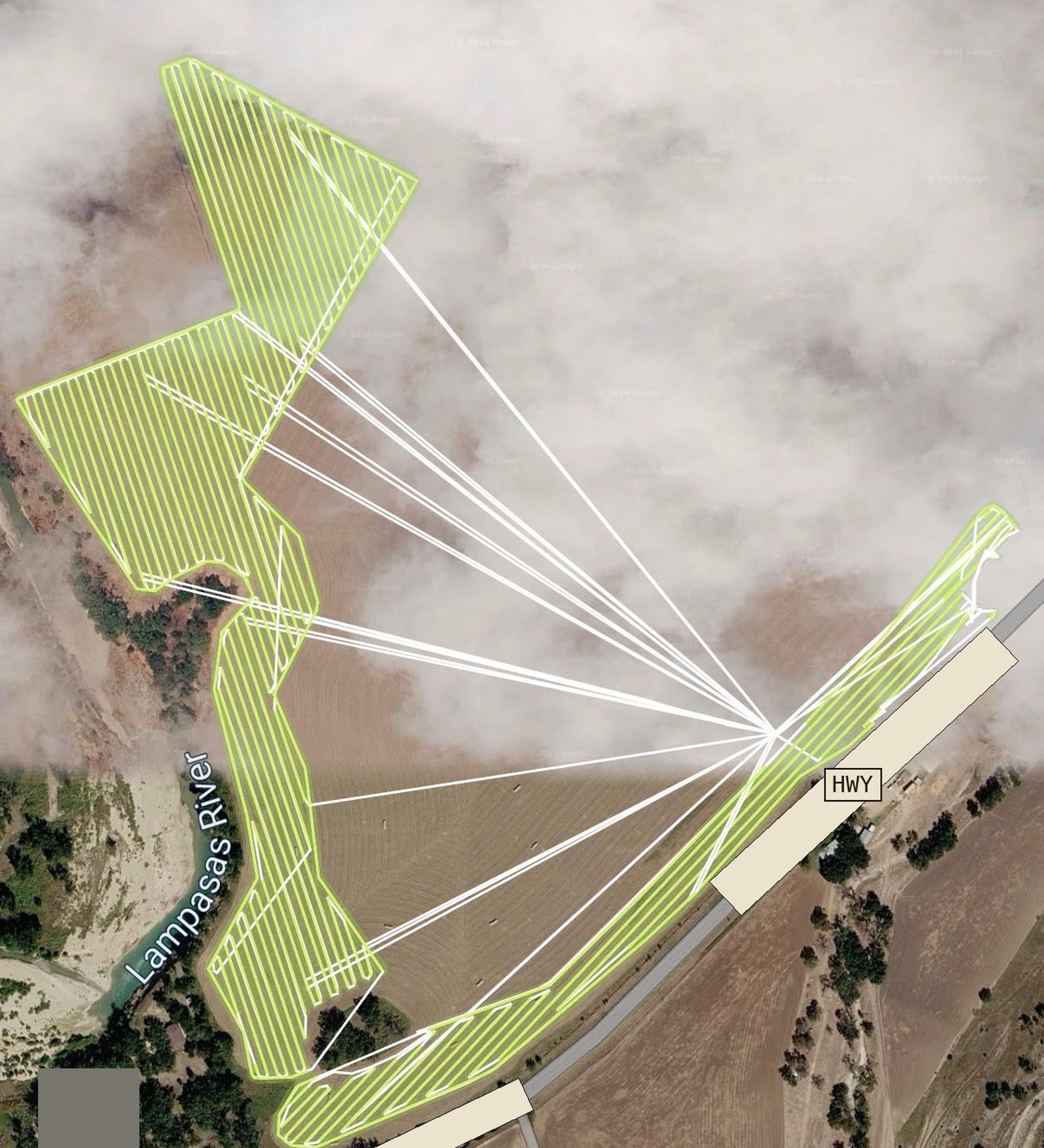
The tank mix is the same one we published in June, and it hasn't changed. A licensed applicator from Agrotech flew the drone and gave us a cool map of the pass after he was done.
What the drone is actually good at
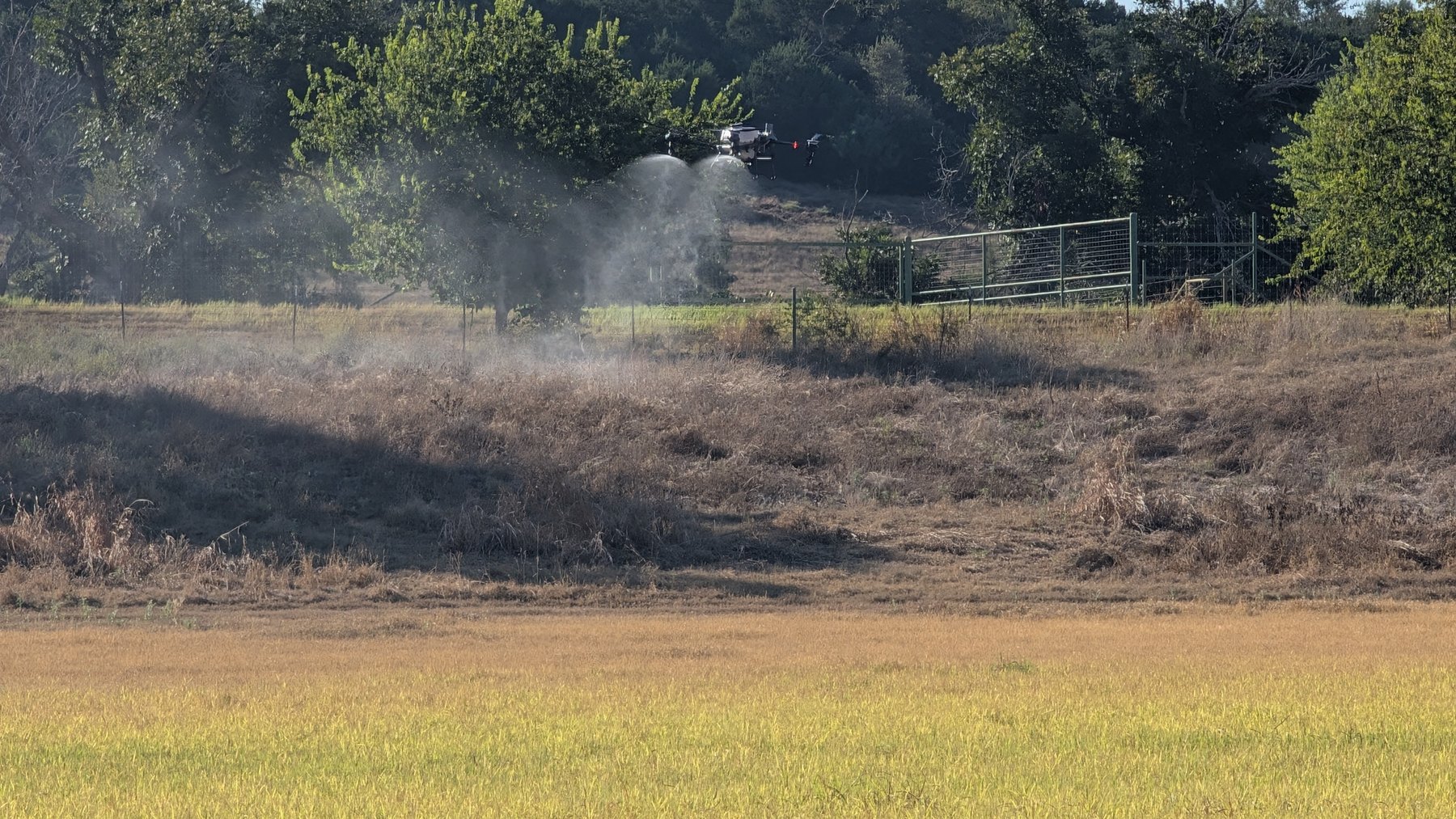
Watching it work the shelterbelt edge is the part that makes the case for doing this by drone rather than a tractor-pulled boom. The band we care about is the brushy, uneven ground between the mown field and the tree line. It's already host to cedar elm, hackberry, and a really beautiful large Chickasaw plum thicket. It's the exact ground where we needed precision, where a tractor can't get in, and it's where the invasive grasses hide close up to the fenceline.
The drone flies about ten feet off the ground, follows the contour, and stops exactly where we want. You can see the edge of the treated band in the photos, exactly where we wanted it.
What we expect from here
We're fairly confident this takes out the rest of the Tifton. What little is left will be taken out by the backpack sprayer or crowded out by the natives. The bluestems and Indiangrass we plant should start outcompeting whatever bermuda is left, and keep outcompeting it long into the future. This is likely a two-to-three-year scenario, but we will keep the backpack sprayer loaded to help it out along the way.
The break
We have a tractor and box blade rented for mid-November to cut a break around the property between the planned native grassland and the Tifton crop we are leaving for a later phase. The two shouldn't be reaching into each other while the natives are trying to establish, and similarly we don't want the natives creeping heavily into a pure Tifton crop. This strip also gives us a loop around the property that we can drive for maintenance, so we don't have to drive through new plantings. Eventually, it will become more of an access road or trail to navigate the land.
The bladed strip won't stay bare, though, as it would erode and grow whatever blows into it. We plan on seeding the break with buffalograss. It's drought-tolerant, native, and low-lying, so it should shade out the Tifton runners. Even if it grows into the Tifton a little, with its low maximum height it shouldn't be a problem for the harvest. It should turn out to be a nice, green, drivable break between the fields.
What the soil came back with
The samples we pulled in July went to the lab at Texas A&M, and we received the results on 28 September. That's the other half of the soil work we started in July. This ground is rich in nearly everything and short on one, and it's an important one for natives.
Potassium, magnesium, sulfur and boron all came back at or above the level where the lab stops recommending anything, on every sample. Calcium runs from 7,500 to 13,500 ppm, which is what typical limestone Hill Country looks like on paper. pH sits between 7.9 and 8.1, moderately alkaline, and the lime requirement is zero. This was all considered a win.
Phosphorus is the exception, and it's incredibly low, likely due to years of the Tifton monoculture sucking it out of the soil. The lab's critical level is 50 ppm. Our four blocks came back at 11, 16, 18 and 18.
The acreages listed are the areas where we actually walked pulling up soil cores, not the size of the sections themselves. A composite sample represents more ground than it covers, and this is in line with the sampling recommendations. The four blocks come to sixteen acres walked, against the thirty and a half under restoration contracts.
Phosphorus is what a native seedling needs to build roots; without it, our chances of success drop significantly. Everything else our land already has, thanks to its limestone and the floods that push the river into the field every five or six years or so.
The nitrogen we decided not to put down
NRCS came back with a recommendation: 75 to 80 pounds an acre of 18-46-0 across the 30.5 acres under contract, to go down before any seed does, sometime this winter.
That blend is 46% phosphate and 18% nitrogen. The phosphate is the point of it, but knowing that the Tifton gets a nitrogen dose every year to boost the harvest, we had some concerns.
Our reading is that the natives going in here don't need much nitrogen, and that the Tifton 85 and Johnsongrass we have spent two seasons trying to kill will take all of it they can get. Putting nitrogen on ground where native seedling establishment is the goal seemed like we would be feeding the enemy. We asked NRCS whether a straight phosphate would satisfy the program instead, and if we could ditch the nitrogen.
Their nutrient management specialist came back with 35 pounds of phosphorus an acre, in whatever form we choose, and said that while the report carries a nitrogen figure he doesn't weigh it much for establishment. The native seed areas get triple superphosphate, 0-45-0, and no nitrogen at all.
Fire, where the thatch is
Some of this ground has years of thatch sitting on it: a section of the Eastern Shelterbelt, and four or five acres of the River Conservation Strip. Our concern is that with the no-till drill we're prescribed, this thatch will prevent our native seed from reaching soil and will suppress new growth from getting up through it. The answer is to burn those acres before we seed.
Unfortunately, Lampasas County is under a burn ban until late December, unless we get a deluge of rain. Until that is lifted, the drip torch stays put away.
What this thirty-five acres is for
It's the proof of concept. If the native stand establishes the way we think it will, the rest of the property follows it into natives in the next two to three years.
The next real milestone is seed in the ground, and we cannot wait for that day.
The satellite record already shows the first pass. The pale ground that opens up from late July in the Long Watch is the June burndown taking hold. This one will show up the same way in a few weeks, and that's how we will confirm a successful full burndown.